
See also: Hypothesis Tests and Confidence Bounds
Uses direct evaluation of the profile likelihood function to determine the bound. The program will attempt to determine the values of the parameter for to eight confidence likelihood- (or score-) based confidence. The default output includes a table of (interpolated) bounds and a profile likelihood (score) plot.
The value of the maximum likelihood estimate for that parameter is saved as #_MLEST and the standard error of this parameter is saved as #_MLESE.
You must specify which parameter the likelihood ratio bound should be computed for using the parameter number. You can choose whether to computer the upper or lower or both bounds.
The Force option forces computation of a bound for a fixed parameter. This is useful when the maximum likelihood estimate occurs on a boundary of the parameter space and you want to compute a one-sided bound. For example, in a linear model for the relative risk of the form 1+βd,
β must be greater than -1/dmax, where dmax is the largest value of d. In some cases, the best estimate may be obtained by fitting a model with β fixed at value near -1/dmax. One can obtain an approximate upper bound using the Force option.
The More option is used to switch to score-based bounds, customize the output (by omitting the plot or bound table or by printing parameter estimates for each iteration.)
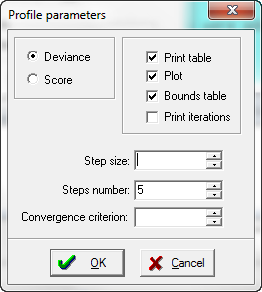
The Step size establishes the value for the initial step length.
Related script commands